






Catalog: YP0580
Size
Price
Status
Qty.
200μL
$600.00
3 weeks
0
100μL
$340.00
3 weeks
0
50μL
$190.00
3 weeks
0
Add to cart


Collected
Collect
Main Information
Target
SH-PTP1 Phospho Tyr536
Host Species
Rabbit
Reactivity
Human, Mouse, Rat
Applications
WB, IHC, IF, ELISA
MW
67kD (Observed)
Conjugate/Modification
phosphate
Detailed Information
Recommended Dilution Ratio
WB 1:500-1:2000; IHC 1:100-1:300; ELISA 1:10000; IF 1:50-200
Formulation
Liquid in PBS containing 50% glycerol, 0.5% BSA and 0.02% sodium azide.
Specificity
Phospho-SH-PTP1 (Y536) Polyclonal Antibody detects endogenous levels of SH-PTP1 protein only when phosphorylated at Y536.The name of modified sites may be influenced by many factors, such as species (the modified site was not originally found in human samples) and the change of protein sequence (the previous protein sequence is incomplete, and the protein sequence may be prolonged with the development of protein sequencing technology). When naming, we will use the "numbers" in historical reference to keep the sites consistent with the reports. The antibody binds to the following modification sequence (lowercase letters are modification sites):SEyGN
Purification
The antibody was affinity-purified from rabbit antiserum by affinity-chromatography using epitope-specific immunogen.
Storage
-15°C to -25°C/1 year (Do not lower than -25°C)
Concentration
1 mg/ml
MW(Observed)
67kD
Modification
phosphate
Clonality
Polyclonal
Isotype
IgG
Related Products
Primary Antibodies

SH-PTP1 Rabbit pAb
YT4292
More→
Primary Antibodies
SH-PTP1 Rabbit pAb
YT4291
More→
Primary Antibodies
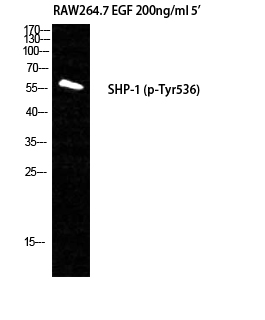
SH-PTP1 (Phospho Tyr536) Rabbit pAb
YP0580
More→
Primary Antibodies
SH-PTP1 (Phospho Tyr564) Rabbit pAb
YP0415
More→
ELISA Kits
Total SHP-1 Cell-Based Colorimetric ELISA Kit
KA4280C
More→
ELISA Kits
SHP-1 (Phospho Tyr564) Cell-Based Colorimetric ELISA Kit
KA1689C
More→
ELISA Kits
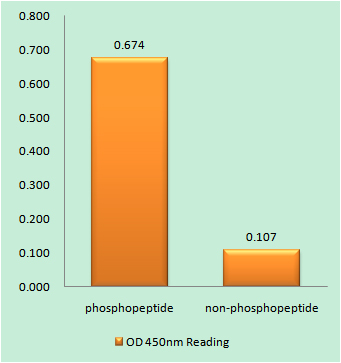
SHP-1 (Phospho Tyr536) Cell-Based Colorimetric ELISA Kit
KA1180C
More→
Antigen&Target Information
Immunogen:
The antiserum was produced against synthesized peptide derived from human SHP-1 around the phosphorylation site of Tyr536. AA range:502-551
show all
Specificity:
Phospho-SH-PTP1 (Y536) Polyclonal Antibody detects endogenous levels of SH-PTP1 protein only when phosphorylated at Y536.The name of modified sites may be influenced by many factors, such as species (the modified site was not originally found in human samples) and the change of protein sequence (the previous protein sequence is incomplete, and the protein sequence may be prolonged with the development of protein sequencing technology). When naming, we will use the "numbers" in historical reference to keep the sites consistent with the reports. The antibody binds to the following modification sequence (lowercase letters are modification sites):SEyGN
show all
Gene Name:
PTPN6
show all
Protein Name:
Tyrosine-protein phosphatase non-receptor type 6
show all
Other Name:
PTPN6 ;
HCP ;
PTP1C ;
Tyrosine-protein phosphatase non-receptor type 6 ;
Hematopoietic cell protein-tyrosine phosphatase ;
Protein-tyrosine phosphatase 1C ;
PTP-1C ;
Protein-tyrosine phosphatase SHP-1 ;
SH-PTP1
HCP ;
PTP1C ;
Tyrosine-protein phosphatase non-receptor type 6 ;
Hematopoietic cell protein-tyrosine phosphatase ;
Protein-tyrosine phosphatase 1C ;
PTP-1C ;
Protein-tyrosine phosphatase SHP-1 ;
SH-PTP1
show all
Database Link:
Background:
The protein encoded by this gene is a member of the protein tyrosine phosphatase (PTP) family. PTPs are known to be signaling molecules that regulate a variety of cellular processes including cell growth , differentiation , mitotic cycle , and oncogenic transformation. N-terminal part of this PTP contains two tandem Src homolog (SH2) domains , which act as protein phospho-tyrosine binding domains , and mediate the interaction of this PTP with its substrates. This PTP is expressed primarily in hematopoietic cells , and functions as an important regulator of multiple signaling pathways in hematopoietic cells. This PTP has been shown to interact with , and dephosphorylate a wide spectrum of phospho-proteins involved in hematopoietic cell signaling. Multiple alternatively spliced variants of this gene , which encode distinct isoforms , have been reported. [provided by RefSeq , Jul
show all
Function:
Catalytic activity:Protein tyrosine phosphate + H (2) O = protein tyrosine + phosphate. ,Function:Plays a key role in hematopoiesis. This PTPase activity may directly link growth factor receptors and other signaling proteins through protein-tyrosine phosphorylation. The SH2 regions may interact with other cellular components to modulate its own phosphatase activity against interacting substrates. Together with MTUS1 , induces UBE2V2 expression upon angiotensin II stimulation. ,PTM:Phosphorylated on serine and tyrosine residues. ,similarity:Belongs to the protein-tyrosine phosphatase family. Non-receptor class 2 subfamily. ,similarity:Contains 1 tyrosine-protein phosphatase domain. ,similarity:Contains 2 SH2 domains. ,subcellular location:In neurons , translocates into the nucleus after treatment with angiotensin II. ,subunit:Monomer. Interacts with MTUS1 (By similarity) . Binds PTPNS1 , LILRB1 and LILRB2. Interacts with FCRL2 , FCRL3 , FCRL4 , CD300LF and CD84. ,tissue specificity:Isoform 1 is expressed in hematopoietic cells while isoform 2 is expressed in non-hematopoietic cells. ,
show all
Cellular Localization:
Cytoplasm. Nucleus. In neurons , translocates into the nucleus after treatment with angiotensin II (By similarity) . Shuttles between the cytoplasm and nucleus via its association with PDPK1. .
show all
Tissue Expression:
Research Areas:
>>Adherens junction ;
>>JAK-STAT signaling pathway ;
>>Natural killer cell mediated cytotoxicity ;
>>T cell receptor signaling pathway ;
>>B cell receptor signaling pathway ;
>>Pathogenic Escherichia coli infection ;
>>Leishmaniasis ;
>>Proteoglycans in cancer ;
>>PD-L1 expression and PD-1 checkpoint pathway in cancer
>>JAK-STAT signaling pathway ;
>>Natural killer cell mediated cytotoxicity ;
>>T cell receptor signaling pathway ;
>>B cell receptor signaling pathway ;
>>Pathogenic Escherichia coli infection ;
>>Leishmaniasis ;
>>Proteoglycans in cancer ;
>>PD-L1 expression and PD-1 checkpoint pathway in cancer
show all
Signaling Pathway
Cellular Processes >> Cellular community - eukaryotes >> Adherens junction
Organismal Systems >> Immune system >> Natural killer cell mediated cytotoxicity
Organismal Systems >> Immune system >> T cell receptor signaling pathway
Organismal Systems >> Immune system >> B cell receptor signaling pathway
Human Diseases >> Cancer: overview >> PD-L1 expression and PD-1 checkpoint pathway in cancer
Environmental Information Processing >> Signal transduction >> JAK-STAT signaling pathway
Reference Citation({{totalcount}})
Catalog: YP0580
Size
Price
Status
Qty.
200μL
$600.00
3 weeks
0
100μL
$340.00
3 weeks
0
50μL
$190.00
3 weeks
0
Add to cart
Collected
Collect
Recently Viewed Products
Clear allPRODUCTS
CUSTOMIZED
ABOUT US



Toggle night Mode
{{pinfoXq.title || ''}}
Catalog: {{pinfoXq.catalog || ''}}
Filter:
All
{{item.name}}
{{pinfo.title}}
-{{pinfo.catalog}}
Main Information
Target
{{pinfo.target}}
Reactivity
{{pinfo.react}}
Applications
{{pinfo.applicat}}
Conjugate/Modification
{{pinfo.coupling}}/{{pinfo.modific}}
MW (kDa)
{{pinfo.mwcalc}}
Host Species
{{pinfo.hostspec}}
Isotype
{{pinfo.isotype}}
Product {{index}}/{{pcount}}
Prev
Next
{{pvTitle}}
Scroll wheel zooms the picture
{{pvDescr}}