






Catalog: YP0707
Size
Price
Status
Qty.
200μL
$600.00
3 weeks
0
100μL
$340.00
3 weeks
0
50μL
$190.00
3 weeks
0
Add to cart


Collected
Collect
Main Information
Target
PLCβ3 Phospho Ser537
Host Species
Rabbit
Reactivity
Human, Mouse, Rat
Applications
WB, IHC, IF, ELISA
MW
150kD (Observed)
Conjugate/Modification
phosphate
Detailed Information
Recommended Dilution Ratio
WB 1:500-1:2000; IHC 1:100-1:300; ELISA 1:10000; IF 1:50-200
Formulation
Liquid in PBS containing 50% glycerol, 0.5% BSA and 0.02% sodium azide.
Specificity
Phospho-PLC β3 (S537) Polyclonal Antibody detects endogenous levels of PLC β3 protein only when phosphorylated at S537.The name of modified sites may be influenced by many factors, such as species (the modified site was not originally found in human samples) and the change of protein sequence (the previous protein sequence is incomplete, and the protein sequence may be prolonged with the development of protein sequencing technology). When naming, we will use the "numbers" in historical reference to keep the sites consistent with the reports. The antibody binds to the following modification sequence (lowercase letters are modification sites):QKsLG
Purification
The antibody was affinity-purified from rabbit antiserum by affinity-chromatography using epitope-specific immunogen.
Storage
-15°C to -25°C/1 year (Do not lower than -25°C)
Concentration
1 mg/ml
MW(Observed)
150kD
Modification
phosphate
Clonality
Polyclonal
Isotype
IgG
RRID
AB_2936919
Related Products
Primary Antibodies
PLCβ3 Rabbit pAb
YT3790
More→
Primary Antibodies
PLCβ3 (Phospho Ser537) Rabbit pAb
YP0707
More→
Primary Antibodies
PLCβ3 (Phospho Ser1105) Rabbit pAb
YP0606
More→
ELISA Kits
Total PLCβ3 Cell-Based Colorimetric ELISA Kit
KA4247C
More→
ELISA Kits
PLCβ3 (Phospho Ser537) Cell-Based Colorimetric ELISA Kit
KA1390C
More→
ELISA Kits
PLCβ3 (Phospho Ser1105) Cell-Based Colorimetric ELISA Kit
KA1212C
More→
Antigen&Target Information
Immunogen:
The antiserum was produced against synthesized peptide derived from human PLC beta3 around the phosphorylation site of Ser537. AA range:503-552
show all
Specificity:
Phospho-PLC β3 (S537) Polyclonal Antibody detects endogenous levels of PLC β3 protein only when phosphorylated at S537.The name of modified sites may be influenced by many factors, such as species (the modified site was not originally found in human samples) and the change of protein sequence (the previous protein sequence is incomplete, and the protein sequence may be prolonged with the development of protein sequencing technology). When naming, we will use the "numbers" in historical reference to keep the sites consistent with the reports. The antibody binds to the following modification sequence (lowercase letters are modification sites):QKsLG
show all
Gene Name:
PLCB3
show all
Protein Name:
1-phosphatidylinositol 4,5-bisphosphate phosphodiesterase beta-3
show all
Other Name:
PLCB3 ;
1-phosphatidylinositol 4 ;
5-bisphosphate phosphodiesterase beta-3 ;
Phosphoinositide phospholipase C-beta-3 ;
Phospholipase C-beta-3 ;
PLC-beta-3
1-phosphatidylinositol 4 ;
5-bisphosphate phosphodiesterase beta-3 ;
Phosphoinositide phospholipase C-beta-3 ;
Phospholipase C-beta-3 ;
PLC-beta-3
show all
Background:
This gene encodes a member of the phosphoinositide phospholipase C beta enzyme family that catalyze the production of the secondary messengers diacylglycerol and inositol 1 ,4 ,5-triphosphate from phosphatidylinositol in G-protein-linked receptor-mediated signal transduction. Alternative splicing results in multiple transcript variants.[provided by RefSeq , May 2010] ,
show all
Function:
Catalytic activity:1-phosphatidyl-1D-myo-inositol 4 ,5-bisphosphate + H (2) O = 1D-myo-inositol 1 ,4 ,5-trisphosphate + diacylglycerol. ,cofactor:Calcium. ,Function:The production of the second messenger molecules diacylglycerol (DAG) and inositol 1 ,4 ,5-trisphosphate (IP3) is mediated by activated phosphatidylinositol-specific phospholipase C enzymes. ,similarity:Contains 1 C2 domain. ,similarity:Contains 1 PI-PLC X-box domain. ,similarity:Contains 1 PI-PLC Y-box domain. ,subunit:Interacts with SHANK2 (By similarity) . Interacts with LPAR2. ,
show all
Cellular Localization:
Cytoplasm . Membrane . Nucleus . And particulate fractions. .
show all
Tissue Expression:
show all
Research Areas:
>>Inositol phosphate metabolism ;
>>Metabolic pathways ;
>>Rap1 signaling pathway ;
>>Calcium signaling pathway ;
>>cGMP-PKG signaling pathway ;
>>Chemokine signaling pathway ;
>>Phosphatidylinositol signaling system ;
>>Sphingolipid signaling pathway ;
>>Phospholipase D signaling pathway ;
>>Adrenergic signaling in cardiomyocytes ;
>>Vascular smooth muscle contraction ;
>>Wnt signaling pathway ;
>>Apelin signaling pathway ;
>>Gap junction ;
>>Platelet activation ;
>>Neutrophil extracellular trap formation ;
>>NOD-like receptor signaling pathway ;
>>Circadian entrainment ;
>>Long-term potentiation ;
>>Retrograde endocannabinoid signaling ;
>>Glutamatergic synapse ;
>>Cholinergic synapse ;
>>Serotonergic synapse ;
>>Dopaminergic synapse ;
>>Long-term depression ;
>>Taste transduction ;
>>Inflammatory mediator regulation of TRP channels ;
>>Insulin secretion ;
>>GnRH signaling pathway ;
>>Estrogen signaling pathway ;
>>Melanogenesis ;
>>Thyroid hormone synthesis ;
>>Thyroid hormone signaling pathway ;
>>Oxytocin signaling pathway ;
>>Glucagon signaling pathway ;
>>Renin secretion ;
>>Aldosterone synthesis and secretion ;
>>Relaxin signaling pathway ;
>>Cortisol synthesis and secretion ;
>>Parathyroid hormone synthesis , secretion and action ;
>>GnRH secretion ;
>>AGE-RAGE signaling pathway in diabetic complications ;
>>Cushing syndrome ;
>>Growth hormone synthesis , secretion and action ;
>>Endocrine and other factor-regulated calcium reabsorption ;
>>Salivary secretion ;
>>Gastric acid secretion ;
>>Pancreatic secretion ;
>>Carbohydrate digestion and absorption ;
>>Alzheimer disease ;
>>Huntington disease ;
>>Spinocerebellar ataxia ;
>>Pathways of neurodegeneration - multiple diseases ;
>>Shigellosis ;
>>Chagas disease ;
>>African trypanosomiasis ;
>>Amoebiasis ;
>>Human cytomegalovirus infection ;
>>Pathways in cancer ;
>>Diabetic cardiomyopathy ;
>>Lipid and atherosclerosis
>>Metabolic pathways ;
>>Rap1 signaling pathway ;
>>Calcium signaling pathway ;
>>cGMP-PKG signaling pathway ;
>>Chemokine signaling pathway ;
>>Phosphatidylinositol signaling system ;
>>Sphingolipid signaling pathway ;
>>Phospholipase D signaling pathway ;
>>Adrenergic signaling in cardiomyocytes ;
>>Vascular smooth muscle contraction ;
>>Wnt signaling pathway ;
>>Apelin signaling pathway ;
>>Gap junction ;
>>Platelet activation ;
>>Neutrophil extracellular trap formation ;
>>NOD-like receptor signaling pathway ;
>>Circadian entrainment ;
>>Long-term potentiation ;
>>Retrograde endocannabinoid signaling ;
>>Glutamatergic synapse ;
>>Cholinergic synapse ;
>>Serotonergic synapse ;
>>Dopaminergic synapse ;
>>Long-term depression ;
>>Taste transduction ;
>>Inflammatory mediator regulation of TRP channels ;
>>Insulin secretion ;
>>GnRH signaling pathway ;
>>Estrogen signaling pathway ;
>>Melanogenesis ;
>>Thyroid hormone synthesis ;
>>Thyroid hormone signaling pathway ;
>>Oxytocin signaling pathway ;
>>Glucagon signaling pathway ;
>>Renin secretion ;
>>Aldosterone synthesis and secretion ;
>>Relaxin signaling pathway ;
>>Cortisol synthesis and secretion ;
>>Parathyroid hormone synthesis , secretion and action ;
>>GnRH secretion ;
>>AGE-RAGE signaling pathway in diabetic complications ;
>>Cushing syndrome ;
>>Growth hormone synthesis , secretion and action ;
>>Endocrine and other factor-regulated calcium reabsorption ;
>>Salivary secretion ;
>>Gastric acid secretion ;
>>Pancreatic secretion ;
>>Carbohydrate digestion and absorption ;
>>Alzheimer disease ;
>>Huntington disease ;
>>Spinocerebellar ataxia ;
>>Pathways of neurodegeneration - multiple diseases ;
>>Shigellosis ;
>>Chagas disease ;
>>African trypanosomiasis ;
>>Amoebiasis ;
>>Human cytomegalovirus infection ;
>>Pathways in cancer ;
>>Diabetic cardiomyopathy ;
>>Lipid and atherosclerosis
show all
Signaling Pathway
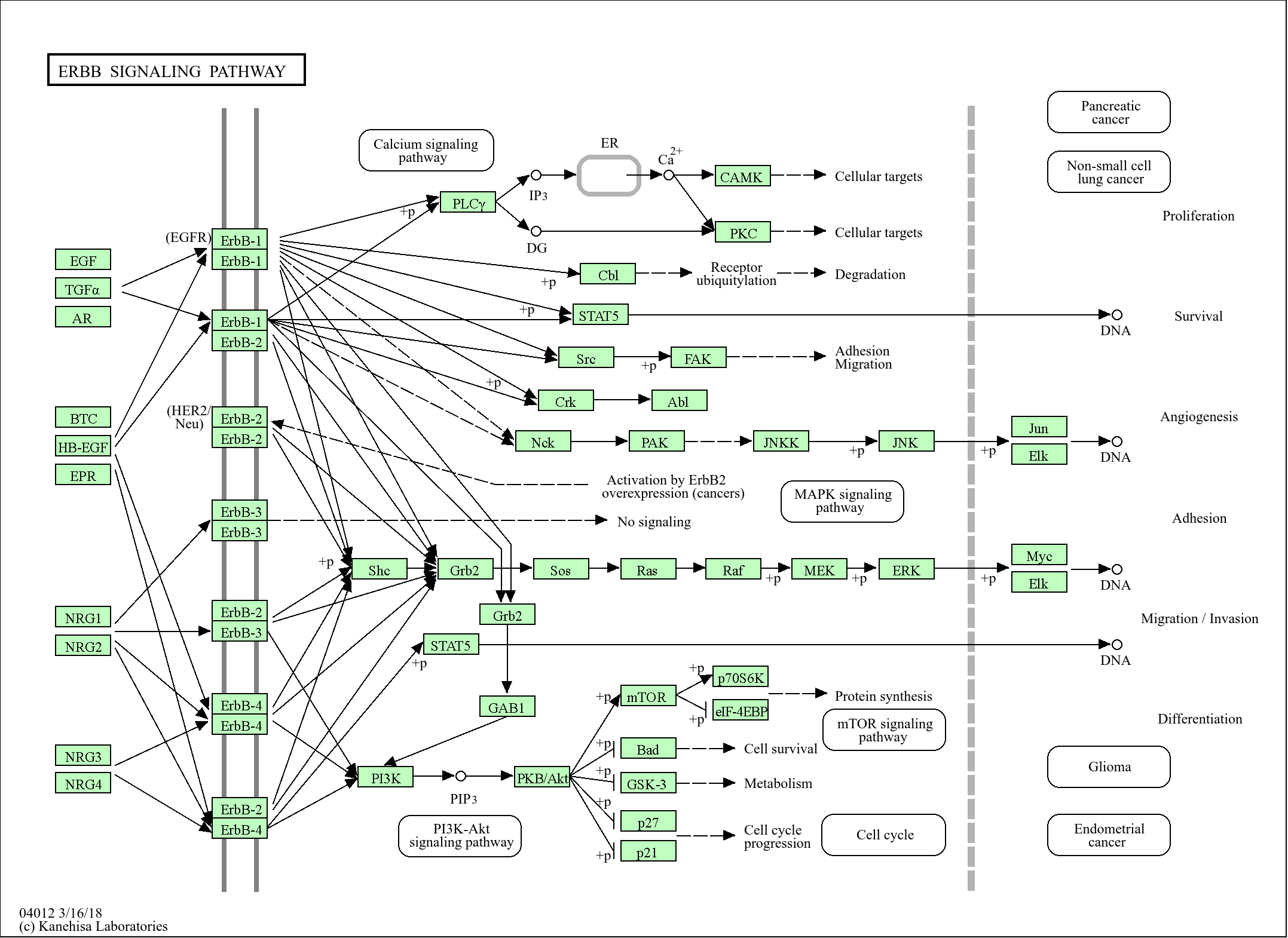
Cellular Processes >> Cellular community - eukaryotes >> Gap junction
Organismal Systems >> Immune system >> Platelet activation
Organismal Systems >> Immune system >> Neutrophil extracellular trap formation
Organismal Systems >> Immune system >> NOD-like receptor signaling pathway
Organismal Systems >> Immune system >> Chemokine signaling pathway
Organismal Systems >> Endocrine system >> Insulin secretion
Organismal Systems >> Endocrine system >> Glucagon signaling pathway
Organismal Systems >> Endocrine system >> GnRH signaling pathway
Organismal Systems >> Endocrine system >> Estrogen signaling pathway
Organismal Systems >> Endocrine system >> Oxytocin signaling pathway
Organismal Systems >> Endocrine system >> Relaxin signaling pathway
Organismal Systems >> Endocrine system >> Growth hormone synthesis, secretion and action
Organismal Systems >> Endocrine system >> Thyroid hormone signaling pathway
Organismal Systems >> Endocrine system >> Aldosterone synthesis and secretion
Organismal Systems >> Circulatory system >> Adrenergic signaling in cardiomyocytes
Organismal Systems >> Circulatory system >> Vascular smooth muscle contraction
Organismal Systems >> Nervous system >> Glutamatergic synapse
Organismal Systems >> Nervous system >> Cholinergic synapse
Organismal Systems >> Nervous system >> Dopaminergic synapse
Organismal Systems >> Sensory system >> Inflammatory mediator regulation of TRP channels
Human Diseases >> Cancer: overview >> Pathways in cancer
Human Diseases >> Neurodegenerative disease >> Alzheimer disease
Human Diseases >> Neurodegenerative disease >> Huntington disease
Human Diseases >> Neurodegenerative disease >> Spinocerebellar ataxia
Human Diseases >> Neurodegenerative disease >> Pathways of neurodegeneration - multiple diseases
Environmental Information Processing >> Signal transduction >> Rap1 signaling pathway
Environmental Information Processing >> Signal transduction >> Wnt signaling pathway
Environmental Information Processing >> Signal transduction >> Apelin signaling pathway
Environmental Information Processing >> Signal transduction >> Calcium signaling pathway
Environmental Information Processing >> Signal transduction >> Phospholipase D signaling pathway
Environmental Information Processing >> Signal transduction >> Sphingolipid signaling pathway
Environmental Information Processing >> Signal transduction >> cGMP-PKG signaling pathway
Reference Citation({{totalcount}})
Catalog: YP0707
Size
Price
Status
Qty.
200μL
$600.00
3 weeks
0
100μL
$340.00
3 weeks
0
50μL
$190.00
3 weeks
0
Add to cart
Collected
Collect
Recently Viewed Products
Clear allPRODUCTS
CUSTOMIZED
ABOUT US



Toggle night Mode
{{pinfoXq.title || ''}}
Catalog: {{pinfoXq.catalog || ''}}
Filter:
All
{{item.name}}
{{pinfo.title}}
-{{pinfo.catalog}}
Main Information
Target
{{pinfo.target}}
Reactivity
{{pinfo.react}}
Applications
{{pinfo.applicat}}
Conjugate/Modification
{{pinfo.coupling}}/{{pinfo.modific}}
MW (kDa)
{{pinfo.mwcalc}}
Host Species
{{pinfo.hostspec}}
Isotype
{{pinfo.isotype}}
Product {{index}}/{{pcount}}
Prev
Next
{{pvTitle}}
Scroll wheel zooms the picture
{{pvDescr}}