



Catalog: YP1664
Size
Price
Status
Qty.
200μL
$600.00
2 weeks
0
100μL
$340.00
2 weeks
0
50μL
$190.00
2 weeks
0
Add to cart


Collected
Collect
Main Information
Target
DYRK1A/B Phospho Tyr321/273
Host Species
Rabbit
Reactivity
Human, Mouse, Rat
Applications
WB
MW
84kD (Calculated)
Conjugate/Modification
phosphate
Detailed Information
Recommended Dilution Ratio
WB 1:500-2000
Formulation
Liquid in PBS containing 50% glycerol, 0.5% BSA and 0.02% sodium azide.
Specificity
This antibody detects endogenous levels of DYRK1A only when phosphorylated at Thr321 and DYRK1B only when phosphorylated at thr273..The name of modified sites may be influenced by many factors, such as species (the modified site was not originally found in human samples) and the change of protein sequence (the previous protein sequence is incomplete, and the protein sequence may be prolonged with the development of protein sequencing technology). When naming, we will use the "numbers" in historical reference to keep the sites consistent with the reports. The antibody binds to the following modification sequence (lowercase letters are modification sites):YQyIQ
Purification
The antibody was affinity-purified from rabbit serum by affinity-chromatography using specific immunogen.
Storage
-15°C to -25°C/1 year (Do not lower than -25°C)
Concentration
1 mg/ml
MW(Calculated)
84kD
Modification
phosphate
Clonality
Polyclonal
Isotype
IgG
Related Products
Secondary Antibodies
Goat Anti Mouse IgG(H+L) (HRP)
RS0001
More→
Secondary Antibodies
Goat Anti Rabbit IgG(H+L) (HRP)
RS0002
More→
Primary Antibodies
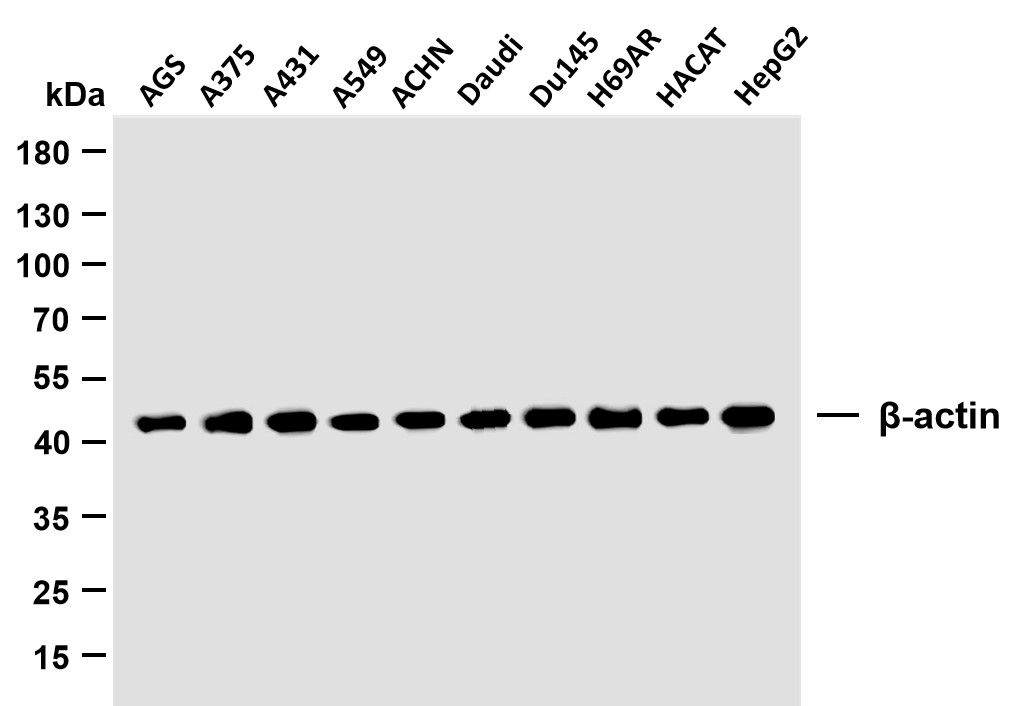
β-actin (PTR2364) Mouse mAb
YM3028
More→
Primary Antibodies
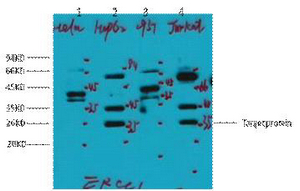
ERCC1 (1B10) Mouse mAb
YM3078
More→
Antigen&Target Information
Immunogen:
Synthesized peptide derived from human DYRK1A/B (Phospho-Tyr321/273)
show all
Specificity:
This antibody detects endogenous levels of DYRK1A only when phosphorylated at Thr321 and DYRK1B only when phosphorylated at thr273..The name of modified sites may be influenced by many factors, such as species (the modified site was not originally found in human samples) and the change of protein sequence (the previous protein sequence is incomplete, and the protein sequence may be prolonged with the development of protein sequencing technology). When naming, we will use the "numbers" in historical reference to keep the sites consistent with the reports. The antibody binds to the following modification sequence (lowercase letters are modification sites):YQyIQ
show all
Gene Name:
DYRK1A DYRK MNB MNBH
show all
Protein Name:
DYRK1A/B (Phospho-Tyr321/273)
show all
Other Name:
DYRK1A ;
DYRK ;
MNB ;
MNBH ;
Dual specificity tyrosine-phosphorylation-regulated kinase 1A ;
Dual specificity YAK1-related kinase ;
HP86 ;
Protein kinase minibrain homolog ;
MNBH ;
hMNB
DYRK ;
MNB ;
MNBH ;
Dual specificity tyrosine-phosphorylation-regulated kinase 1A ;
Dual specificity YAK1-related kinase ;
HP86 ;
Protein kinase minibrain homolog ;
MNBH ;
hMNB
show all
Database Link:
Background:
This gene encodes a member of the Dual-specificity tyrosine phosphorylation-regulated kinase (DYRK) family. This member contains a nuclear targeting signal sequence , a protein kinase domain , a leucine zipper motif , and a highly conservative 13-consecutive-histidine repeat. It catalyzes its autophosphorylation on serine/threonine and tyrosine residues. It may play a significant role in a signaling pathway regulating cell proliferation and may be involved in brain development. This gene is a homolog of Drosophila mnb (minibrain) gene and rat Dyrk gene. It is localized in the Down syndrome critical region of chromosome 21 , and is considered to be a strong candidate gene for learning defects associated with Down syndrome. Alternative splicing of this gene generates several transcript variants differing from each other either in the 5' UTR or in the 3' co
show all
Function:
Alternative products:Additional isoforms seem to exist ,Catalytic activity:ATP + a protein = ADP + a phosphoprotein. ,developmental stage:Expressed in the developing central nervous system. ,Disease:Overexpressed 1.5-fold in fetal Down syndrome brain. ,enzyme regulation:Inhibited by RANBP9. ,Function:May play a role in a signaling pathway regulating nuclear functions of cell proliferation. Phosphorylates serine , threonine and tyrosine residues in its sequence and in exogenous substrates. ,PTM:Autophosphorylated on tyrosine residues. ,similarity:Belongs to the protein kinase superfamily. CMGC Ser/Thr protein kinase family. MNB/DYRK subfamily. ,similarity:Contains 1 protein kinase domain. ,subunit:Interacts RAD54L2/ARIP4 (By similarity) . Interacts with RANBP9. ,tissue specificity:Ubiquitous. Highest levels in skeletal muscle , testis , fetal lung and fetal kidney. ,
show all
Cellular Localization:
Nucleus . Nucleus speckle .
show all
Tissue Expression:
Reference Citation({{totalcount}})
Catalog: YP1664
Size
Price
Status
Qty.
200μL
$600.00
2 weeks
0
100μL
$340.00
2 weeks
0
50μL
$190.00
2 weeks
0
Add to cart
Collected
Collect
Recently Viewed Products
Clear allPRODUCTS
CUSTOMIZED
ABOUT US



Toggle night Mode
{{pinfoXq.title || ''}}
Catalog: {{pinfoXq.catalog || ''}}
Filter:
All
{{item.name}}
{{pinfo.title}}
-{{pinfo.catalog}}
Main Information
Target
{{pinfo.target}}
Reactivity
{{pinfo.react}}
Applications
{{pinfo.applicat}}
Conjugate/Modification
{{pinfo.coupling}}/{{pinfo.modific}}
MW (kDa)
{{pinfo.mwcalc}}
Host Species
{{pinfo.hostspec}}
Isotype
{{pinfo.isotype}}
Product {{index}}/{{pcount}}
Prev
Next
{{pvTitle}}
Scroll wheel zooms the picture
{{pvDescr}}