



Catalog: YP1360
Size
Price
Status
Qty.
200μL
$600.00
3 weeks
0
100μL
$340.00
3 weeks
0
50μL
$190.00
3 weeks
0
Add to cart


Collected
Collect
Main Information
Target
IGF-1R Phospho Tyr1316
Host Species
Rabbit
Reactivity
Human, Mouse
Applications
WB
MW
pro:155kD,recetor beta:95kD (Observed)
Conjugate/Modification
phosphate
Detailed Information
Recommended Dilution Ratio
WB 1:1000-2000
Formulation
Liquid in PBS containing 50% glycerol, 0.5% BSA and 0.02% sodium azide.
Specificity
This antibody detects endogenous levels of Human Mouse IGF-I Receptor β (phospho-Tyr1316)
Purification
The antibody was affinity-purified from rabbit serum by affinity-chromatography using specific immunogen.
Storage
-15°C to -25°C/1 year (Do not lower than -25°C)
Concentration
1 mg/ml
MW(Observed)
pro:155kD,recetor beta:95kD
Modification
phosphate
Clonality
Polyclonal
Isotype
IgG
Related Products
Secondary Antibodies
Goat Anti Mouse IgG(H+L) (HRP)
RS0001
More→
Secondary Antibodies
Goat Anti Rabbit IgG(H+L) (HRP)
RS0002
More→
Primary Antibodies
β-actin (PTR2364) Mouse mAb
YM3028
More→
Primary Antibodies
GAPDH (PTR2304) Mouse mAb
YM3029
More→
Antigen&Target Information
Immunogen:
Synthesized phosho peptide around human IGF-I Receptor β (Tyr1316)
show all
Specificity:
This antibody detects endogenous levels of Human Mouse IGF-I Receptor β (phospho-Tyr1316)
show all
Gene Name:
IGF1R
show all
Protein Name:
IGF-I Receptor β (Tyr1316)
show all
Other Name:
Insulin-like growth factor 1 receptor ;
Insulin-like growth factor I receptor ;
IGF-I receptor ;
CD antigen CD221 ;
[Cleaved into: Insulin-like growth factor 1 receptor alpha chain ;
Insulin-like growth factor 1 receptor beta chain]
Insulin-like growth factor I receptor ;
IGF-I receptor ;
CD antigen CD221 ;
[Cleaved into: Insulin-like growth factor 1 receptor alpha chain ;
Insulin-like growth factor 1 receptor beta chain]
show all
Background:
This receptor binds insulin-like growth factor with a high affinity. It has tyrosine kinase activity. The insulin-like growth factor I receptor plays a critical role in transformation events. Cleavage of the precursor generates alpha and beta subunits. It is highly overexpressed in most malignant tissues where it functions as an anti-apoptotic agent by enhancing cell survival. Alternatively spliced transcript variants encoding distinct isoforms have been found for this gene. [provided by RefSeq , May 2014] ,
show all
Function:
Catalytic activity:ATP + a [protein]-L-tyrosine = ADP + a [protein]-L-tyrosine phosphate. ,Disease:Defects in IGF1R may be a cause in some cases of resistance to insulin-like growth factor 1 (IGF1 resistance) [MIM:270450]. IGF1 resistance is a gowth deficiency disorder characterized by intrauterine growth retardation and poor postnatal growth accompanied with increased plasma IGF1. ,enzyme regulation:Autophosphorylation activates the kinase activity. ,Function:This receptor binds insulin-like growth factor 1 (IGF1) with a high affinity and IGF2 with a lower affinity. It has a tyrosine-protein kinase activity , which is necessary for the activation of the IGF1-stimulated downstream signaling cascade. When present in a hybrid receptor with INSR , binds IGF1. PubMed:12138094 shows that hybrid receptors composed of IGF1R and INSR isoform Long are activated with a high affinity by IGF1 , with low affinity by IGF2 and not significantly activated by insulin , and that hybrid receptors composed of IGF1R and INSR isoform Short are activated by IGF1 , IGF2 and insulin. In contrast , PubMed:16831875 shows that hybrid receptors composed of IGF1R and INSR isoform Long and hybrid receptors composed of IGF1R and INSR isoform Short have similar binding characteristics , both bind IGF1 and have a low affinity for insulin. ,online information:IGF-1 receptor entry ,PTM:Phosphorylation of Tyr-980 is required for IRS1- and SHC1-binding. ,PTM:The cytoplasmic domain of the beta subunit is autophosphorylated on tyrosine residues in response to insulin-like growth factor I (IGF I) . ,similarity:Belongs to the protein kinase superfamily. Tyr protein kinase family. Insulin receptor subfamily. ,similarity:Contains 1 protein kinase domain. ,similarity:Contains 3 fibronectin type-III domains. ,subunit:Tetramer of 2 alpha and 2 beta chains linked by disulfide bonds. The alpha chains contribute to the formation of the ligand-binding domain , while the beta chain carries the kinase domain. Interacts with PIK3R1 and with the PTB/PID domains of IRS1 and SHC1 in vitro when autophosphorylated on tyrosine residues. Forms a hybrid receptor with INSR , the hybrid is a tetramer consisting of 1 alpha chain and 1 beta chain of INSR and 1 alpha chain and 1 beta chain of IGF1R. ,tissue specificity:Found as a hybrid receptor with INSR in muscle , heart , kidney , adipose tissue , skeletal muscle , hepatoma , fibrobasts , spleen and placenta (at protein level) . Expressed in a variety of tissues. ,
show all
Cellular Localization:
Cell membrane ; Single-pass type I membrane protein .
show all
Research Areas:
>>EGFR tyrosine kinase inhibitor resistance ;
>>Endocrine resistance ;
>>MAPK signaling pathway ;
>>Ras signaling pathway ;
>>Rap1 signaling pathway ;
>>HIF-1 signaling pathway ;
>>FoxO signaling pathway ;
>>Oocyte meiosis ;
>>Autophagy - animal ;
>>Endocytosis ;
>>mTOR signaling pathway ;
>>PI3K-Akt signaling pathway ;
>>AMPK signaling pathway ;
>>Longevity regulating pathway ;
>>Longevity regulating pathway - multiple species ;
>>Focal adhesion ;
>>Adherens junction ;
>>Signaling pathways regulating pluripotency of stem cells ;
>>Long-term depression ;
>>Ovarian steroidogenesis ;
>>Progesterone-mediated oocyte maturation ;
>>Pathways in cancer ;
>>Transcriptional misregulation in cancer ;
>>Proteoglycans in cancer ;
>>Glioma ;
>>Prostate cancer ;
>>Melanoma ;
>>Breast cancer ;
>>Hepatocellular carcinoma
>>Endocrine resistance ;
>>MAPK signaling pathway ;
>>Ras signaling pathway ;
>>Rap1 signaling pathway ;
>>HIF-1 signaling pathway ;
>>FoxO signaling pathway ;
>>Oocyte meiosis ;
>>Autophagy - animal ;
>>Endocytosis ;
>>mTOR signaling pathway ;
>>PI3K-Akt signaling pathway ;
>>AMPK signaling pathway ;
>>Longevity regulating pathway ;
>>Longevity regulating pathway - multiple species ;
>>Focal adhesion ;
>>Adherens junction ;
>>Signaling pathways regulating pluripotency of stem cells ;
>>Long-term depression ;
>>Ovarian steroidogenesis ;
>>Progesterone-mediated oocyte maturation ;
>>Pathways in cancer ;
>>Transcriptional misregulation in cancer ;
>>Proteoglycans in cancer ;
>>Glioma ;
>>Prostate cancer ;
>>Melanoma ;
>>Breast cancer ;
>>Hepatocellular carcinoma
show all
Signaling Pathway
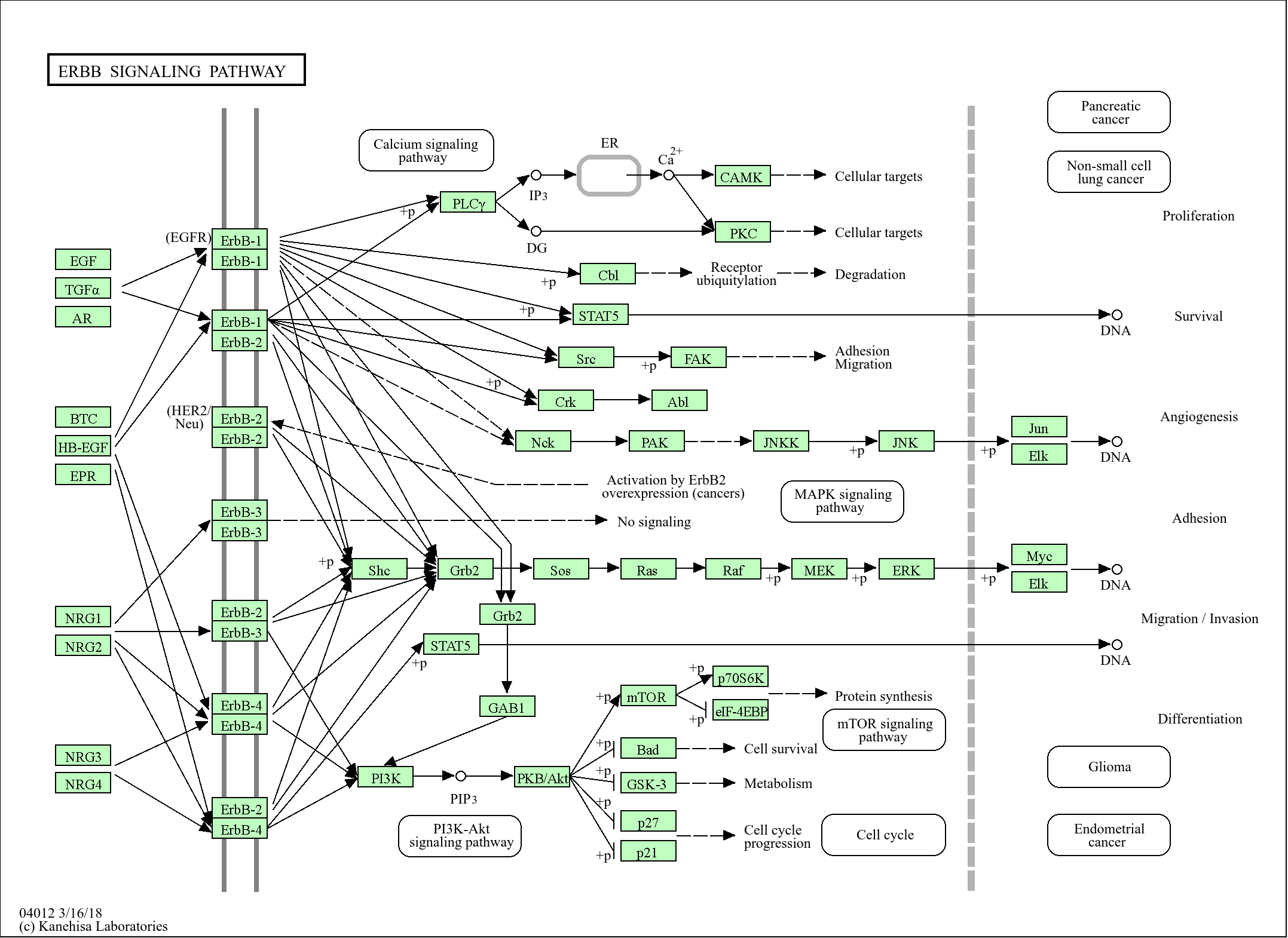
Cellular Processes >> Transport and catabolism >> Autophagy - animal
Cellular Processes >> Cellular community - eukaryotes >> Focal adhesion
Cellular Processes >> Cellular community - eukaryotes >> Adherens junction
Cellular Processes >> Cellular community - eukaryotes >> Signaling pathways regulating pluripotency of stem cells
Organismal Systems >> Aging >> Longevity regulating pathway
Organismal Systems >> Aging >> Longevity regulating pathway - multiple species
Human Diseases >> Cancer: overview >> Pathways in cancer
Human Diseases >> Cancer: overview >> Transcriptional misregulation in cancer
Human Diseases >> Cancer: specific types >> Hepatocellular carcinoma
Human Diseases >> Cancer: specific types >> Glioma
Human Diseases >> Cancer: specific types >> Melanoma
Human Diseases >> Cancer: specific types >> Prostate cancer
Human Diseases >> Cancer: specific types >> Breast cancer
Environmental Information Processing >> Signal transduction >> MAPK signaling pathway
Environmental Information Processing >> Signal transduction >> Ras signaling pathway
Environmental Information Processing >> Signal transduction >> Rap1 signaling pathway
Environmental Information Processing >> Signal transduction >> HIF-1 signaling pathway
Environmental Information Processing >> Signal transduction >> FoxO signaling pathway
Environmental Information Processing >> Signal transduction >> PI3K-Akt signaling pathway
Environmental Information Processing >> Signal transduction >> AMPK signaling pathway
Environmental Information Processing >> Signal transduction >> mTOR signaling pathway
Reference Citation({{totalcount}})
Catalog: YP1360
Size
Price
Status
Qty.
200μL
$600.00
3 weeks
0
100μL
$340.00
3 weeks
0
50μL
$190.00
3 weeks
0
Add to cart
Collected
Collect
Recently Viewed Products
Clear allPRODUCTS
CUSTOMIZED
ABOUT US



Toggle night Mode
{{pinfoXq.title || ''}}
Catalog: {{pinfoXq.catalog || ''}}
Filter:
All
{{item.name}}
{{pinfo.title}}
-{{pinfo.catalog}}
Main Information
Target
{{pinfo.target}}
Reactivity
{{pinfo.react}}
Applications
{{pinfo.applicat}}
Conjugate/Modification
{{pinfo.coupling}}/{{pinfo.modific}}
MW (kDa)
{{pinfo.mwcalc}}
Host Species
{{pinfo.hostspec}}
Isotype
{{pinfo.isotype}}
Product {{index}}/{{pcount}}
Prev
Next
{{pvTitle}}
Scroll wheel zooms the picture
{{pvDescr}}