


Catalog: YM3754
Size
Price
Status
Qty.
200μL
$600.00
3 weeks
0
100μL
$340.00
3 weeks
0
40μL
$190.00
3 weeks
0
Add to cart


Collected
Collect
Main Information
Target
NFκB p65 Acetyl Lys314/Lys315
Host Species
Mouse
Reactivity
Human, Mouse, Rat
Applications
IHC, IF
MW
65kD (Observed)
Conjugate/Modification
acetylate
Detailed Information
Recommended Dilution Ratio
IHC 1:50-300; IF 1:50-200
Formulation
Liquid in PBS containing 50% glycerol, 0.5% BSA and 0.02% sodium azide.
Specificity
This antibody detects endogenous levels of NFkB p65 only when acetylated at Lys314 or Lys315 and dually acetylated at two sites..
Purification
The antibody was affinity-purified from mouse antiserum by affinity-chromatography using epitope-specific immunogen.
Storage
-15°C to -25°C/1 year (Do not lower than -25°C)
Concentration
1 mg/ml
MW(Observed)
65kD
Modification
acetylate
Clonality
Monoclonal
Clone Number
2A11
Related Products
Secondary Antibodies
Goat Anti Mouse IgG(H+L) (HRP)
RS0001
More→
Secondary Antibodies
Goat Anti Rabbit IgG(H+L) (HRP)
RS0002
More→
Primary Antibodies
β-actin (PTR2364) Mouse mAb
YM3028
More→
Primary Antibodies
GAPDH (PTR2304) Mouse mAb
YM3029
More→
Antigen&Target Information
Immunogen:
Synthetic Peptide of Acetyl NF kB P65(K314/K315)
show all
Specificity:
This antibody detects endogenous levels of NFkB p65 only when acetylated at Lys314 or Lys315 and dually acetylated at two sites..
show all
Gene Name:
RELA
show all
Protein Name:
Transcription factor p65
show all
Other Name:
Transcription factor p65 ;
Nuclear factor NF-kappa-B p65 subunit ;
Nuclear factor of kappa light polypeptide gene enhancer in B-cells 3 ;
Nuclear factor NF-kappa-B p65 subunit ;
Nuclear factor of kappa light polypeptide gene enhancer in B-cells 3 ;
show all
Background:
NF-kappa-B is a ubiquitous transcription factor involved in several biological processes. It is held in the cytoplasm in an inactive state by specific inhibitors. Upon degradation of the inhibitor , NF-kappa-B moves to the nucleus and activates transcription of specific genes. NF-kappa-B is composed of NFKB1 or NFKB2 bound to either REL , RELA , or RELB. The most abundant form of NF-kappa-B is NFKB1 complexed with the product of this gene , RELA. Four transcript variants encoding different isoforms have been found for this gene. [provided by RefSeq , Sep 2011] ,
show all
Function:
Function:NF-kappa-B is a pleiotropic transcription factor which is present in almost all cell types and is involved in many biological processed such as inflammation , immunity , differentiation , cell growth , tumorigenesis and apoptosis. NF-kappa-B is a homo- or heterodimeric complex formed by the Rel-like domain-containing proteins RELA/p65 , RELB , NFKB1/p105 , NFKB1/p50 , REL and NFKB2/p52 and the heterodimeric p65-p50 complex appears to be most abundant one. The dimers bind at kappa-B sites in the DNA of their target genes and the individual dimers have distinct preferences for different kappa-B sites that they can bind with distinguishable affinity and specificity. Different dimer combinations act as transcriptional activators or repressors , respectively. NF-kappa-B is controlled by various mechanisms of post-translational modification and subcellular compartmentalization as well as by interactions with other cofactors or corepressors. NF-kappa-B complexes are held in the cytoplasm in an inactive state complexed with members of the NF-kappa-B inhibitor (I-kappa-B) family. In a conventional activation pathway , I-kappa-B is phosphorylated by I-kappa-B kinases (IKKs) in response to different activators , subsequently degraded thus liberating the active NF-kappa-B complex which translocates to the nucleus. NF-kappa-B heterodimeric p65-p50 and p65-c-Rel complexes are transcriptional activators. The NF-kappa-B p65-p65 complex appears to be involved in invasin-mediated activation of IL-8 expression. The inhibitory effect of I-kappa-B upon NF-kappa-B the cytoplasm is exerted primarily through the interaction with p65. p65 shows a weak DNA-binding site which could contribute directly to DNA binding in the NF-kappa-B complex. ,PTM:Phosphorylation on 'Ser-536' stimulates acetylation on 'Lys-310' and interaction with CBP; the phosphorylated and acetylated forms show enhanced transcriptional activity. ,PTM:Reversibly acetylated; the acetylation seems to be mediated by CBP , the deacetylation by HDAC3. Acetylation at 'Lys-122' enhances DNA binding and impairs association with NFKBIA. Acetylation at 'Lys-310' is required for full transcriptional activity in the absence of effects on DNA binding and NFKBIA association. Acetylation can also lower DNA-binding and results in nuclear export. ,PTM:Ubiquitinated , leading to its proteosomal degradation. Degradation is required for termination of NF-kappa-B response. ,similarity:Contains 1 RHD (Rel-like) domain. ,subcellular location:Nuclear , but also found in the cytoplasm in an inactive form complexed to an inhibitor (I-kappa-B) . ,subunit:Component of the NF-kappa-B p65-p50 complex. Component of the NF-kappa-B p65-c-Rel complex. Homodimer; component of the NF-kappa-B p65-p65 complex. Component of the NF-kappa-B p65-p52 complex. May interact with ETHE1. Binds AES and TLE1. Interacts with TP53BP2. Binds to and is phosphorylated by the activated form of either RPS6KA4 or RPS6KA5. Interacts with ING4 and this interaction may be indirect. Interacts with CARM1 , USP48 and UNC5CL. Interacts with IRAK1BP1 (By similarity) .Interacts with NFKBID (By similarity) . Interacts with NFKBIA. Interacts with GSK3B. Interacts with NFKBIB (By similarity) . Interacts with NFKBIE. Interacts with NFKBIZ (By similarity) . Part of a 70-90 kDa complex at least consisting of CHUK , IKBKB , NFKBIA , RELA , IKBKAP and MAP3K14. Interacts with HDAC3; HDAC3 mediates the deacetylation of RELA. Interacts with HDAC1; the interaction requires non-phosphorylated RELA. Interacts with CBP; the interaction requires phosphorylated RELA. Interacts (phosphorylated at 'Thr-254') with PIN1; the interaction inhibits p65 binding to NFKBIA. Interacts with SOCS1. Interacts with UXT. Interacts with MTDH. Interacts with human respiratory syncytial virus (HRSV) protein M2-1. ,
show all
Cellular Localization:
Nucleus . Cytoplasm . Nuclear , but also found in the cytoplasm in an inactive form complexed to an inhibitor (I-kappa-B) (PubMed:1493333) . Colocalized with DDX1 in the nucleus upon TNF-alpha induction (PubMed:19058135) . Colocalizes with GFI1 in the nucleus after LPS stimulation (PubMed:20547752) . Translocation to the nucleus is impaired in L.monocytogenes infection (PubMed:20855622) . .
show all
Tissue Expression:
show all
Research Areas:
>>Antifolate resistance ;
>>MAPK signaling pathway ;
>>Ras signaling pathway ;
>>cAMP signaling pathway ;
>>Chemokine signaling pathway ;
>>NF-kappa B signaling pathway ;
>>HIF-1 signaling pathway ;
>>Sphingolipid signaling pathway ;
>>Mitophagy - animal ;
>>PI3K-Akt signaling pathway ;
>>Apoptosis ;
>>Longevity regulating pathway ;
>>Cellular senescence ;
>>Osteoclast differentiation ;
>>Neutrophil extracellular trap formation ;
>>Toll-like receptor signaling pathway ;
>>NOD-like receptor signaling pathway ;
>>RIG-I-like receptor signaling pathway ;
>>Cytosolic DNA-sensing pathway ;
>>C-type lectin receptor signaling pathway ;
>>IL-17 signaling pathway ;
>>Th1 and Th2 cell differentiation ;
>>Th17 cell differentiation ;
>>T cell receptor signaling pathway ;
>>B cell receptor signaling pathway ;
>>TNF signaling pathway ;
>>Neurotrophin signaling pathway ;
>>Prolactin signaling pathway ;
>>Adipocytokine signaling pathway ;
>>Relaxin signaling pathway ;
>>Insulin resistance ;
>>Non-alcoholic fatty liver disease ;
>>AGE-RAGE signaling pathway in diabetic complications ;
>>Alcoholic liver disease ;
>>Alzheimer disease ;
>>Pathways of neurodegeneration - multiple diseases ;
>>Cocaine addiction ;
>>Epithelial cell signaling in Helicobacter pylori infection ;
>>Pathogenic Escherichia coli infection ;
>>Shigellosis ;
>>Salmonella infection ;
>>Pertussis ;
>>Legionellosis ;
>>Yersinia infection ;
>>Leishmaniasis ;
>>Chagas disease ;
>>Toxoplasmosis ;
>>Amoebiasis ;
>>Tuberculosis ;
>>Hepatitis C ;
>>Hepatitis B ;
>>Measles ;
>>Human cytomegalovirus infection ;
>>Influenza A ;
>>Human papillomavirus infection ;
>>Human T-cell leukemia virus 1 infection ;
>>Kaposi sarcoma-associated herpesvirus infection ;
>>Herpes simplex virus 1 infection ;
>>Epstein-Barr virus infection ;
>>Human immunodeficiency virus 1 infection ;
>>Coronavirus disease - COVID-19 ;
>>Pathways in cancer ;
>>Transcriptional misregulation in cancer ;
>>Viral carcinogenesis ;
>>Chemical carcinogenesis - receptor activation ;
>>Chemical carcinogenesis - reactive oxygen species ;
>>Pancreatic cancer ;
>>Prostate cancer ;
>>Chronic myeloid leukemia ;
>>Acute myeloid leukemia ;
>>Small cell lung cancer ;
>>PD-L1 expression and PD-1 checkpoint pathway in cancer ;
>>Inflammatory bowel disease ;
>>Diabetic cardiomyopathy ;
>>Lipid and atherosclerosis ;
>>Fluid shear stress and atherosclerosis
>>MAPK signaling pathway ;
>>Ras signaling pathway ;
>>cAMP signaling pathway ;
>>Chemokine signaling pathway ;
>>NF-kappa B signaling pathway ;
>>HIF-1 signaling pathway ;
>>Sphingolipid signaling pathway ;
>>Mitophagy - animal ;
>>PI3K-Akt signaling pathway ;
>>Apoptosis ;
>>Longevity regulating pathway ;
>>Cellular senescence ;
>>Osteoclast differentiation ;
>>Neutrophil extracellular trap formation ;
>>Toll-like receptor signaling pathway ;
>>NOD-like receptor signaling pathway ;
>>RIG-I-like receptor signaling pathway ;
>>Cytosolic DNA-sensing pathway ;
>>C-type lectin receptor signaling pathway ;
>>IL-17 signaling pathway ;
>>Th1 and Th2 cell differentiation ;
>>Th17 cell differentiation ;
>>T cell receptor signaling pathway ;
>>B cell receptor signaling pathway ;
>>TNF signaling pathway ;
>>Neurotrophin signaling pathway ;
>>Prolactin signaling pathway ;
>>Adipocytokine signaling pathway ;
>>Relaxin signaling pathway ;
>>Insulin resistance ;
>>Non-alcoholic fatty liver disease ;
>>AGE-RAGE signaling pathway in diabetic complications ;
>>Alcoholic liver disease ;
>>Alzheimer disease ;
>>Pathways of neurodegeneration - multiple diseases ;
>>Cocaine addiction ;
>>Epithelial cell signaling in Helicobacter pylori infection ;
>>Pathogenic Escherichia coli infection ;
>>Shigellosis ;
>>Salmonella infection ;
>>Pertussis ;
>>Legionellosis ;
>>Yersinia infection ;
>>Leishmaniasis ;
>>Chagas disease ;
>>Toxoplasmosis ;
>>Amoebiasis ;
>>Tuberculosis ;
>>Hepatitis C ;
>>Hepatitis B ;
>>Measles ;
>>Human cytomegalovirus infection ;
>>Influenza A ;
>>Human papillomavirus infection ;
>>Human T-cell leukemia virus 1 infection ;
>>Kaposi sarcoma-associated herpesvirus infection ;
>>Herpes simplex virus 1 infection ;
>>Epstein-Barr virus infection ;
>>Human immunodeficiency virus 1 infection ;
>>Coronavirus disease - COVID-19 ;
>>Pathways in cancer ;
>>Transcriptional misregulation in cancer ;
>>Viral carcinogenesis ;
>>Chemical carcinogenesis - receptor activation ;
>>Chemical carcinogenesis - reactive oxygen species ;
>>Pancreatic cancer ;
>>Prostate cancer ;
>>Chronic myeloid leukemia ;
>>Acute myeloid leukemia ;
>>Small cell lung cancer ;
>>PD-L1 expression and PD-1 checkpoint pathway in cancer ;
>>Inflammatory bowel disease ;
>>Diabetic cardiomyopathy ;
>>Lipid and atherosclerosis ;
>>Fluid shear stress and atherosclerosis
show all
Signaling Pathway
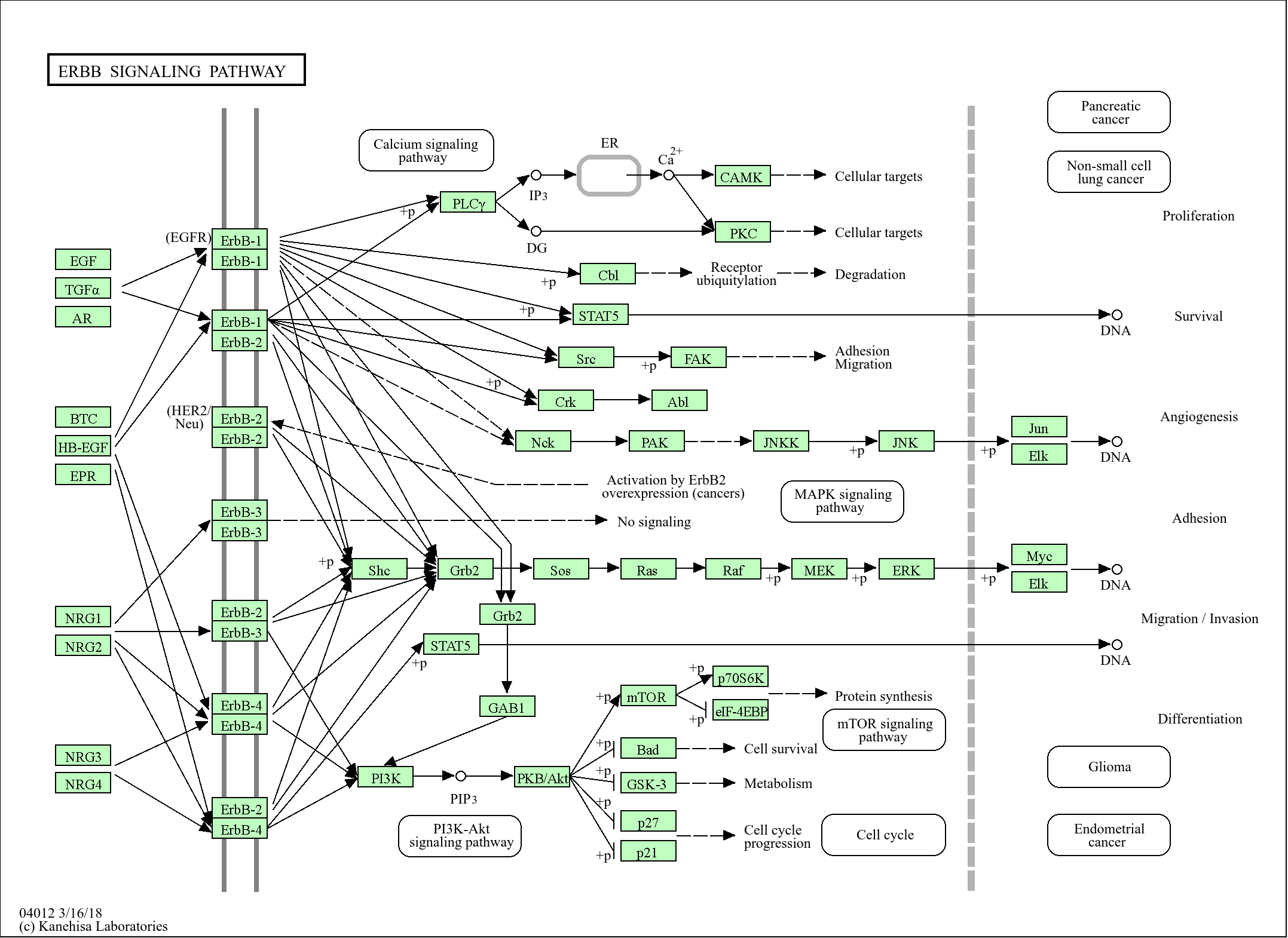
Cellular Processes >> Transport and catabolism >> Mitophagy - animal
Cellular Processes >> Cell growth and death >> Apoptosis
Cellular Processes >> Cell growth and death >> Cellular senescence
Organismal Systems >> Immune system >> Neutrophil extracellular trap formation
Organismal Systems >> Immune system >> Toll-like receptor signaling pathway
Organismal Systems >> Immune system >> NOD-like receptor signaling pathway
Organismal Systems >> Immune system >> RIG-I-like receptor signaling pathway
Organismal Systems >> Immune system >> Cytosolic DNA-sensing pathway
Organismal Systems >> Immune system >> T cell receptor signaling pathway
Organismal Systems >> Immune system >> Th1 and Th2 cell differentiation
Organismal Systems >> Immune system >> Th17 cell differentiation
Organismal Systems >> Immune system >> IL-17 signaling pathway
Organismal Systems >> Immune system >> B cell receptor signaling pathway
Organismal Systems >> Immune system >> Chemokine signaling pathway
Organismal Systems >> Endocrine system >> Adipocytokine signaling pathway
Organismal Systems >> Endocrine system >> Prolactin signaling pathway
Organismal Systems >> Endocrine system >> Relaxin signaling pathway
Organismal Systems >> Nervous system >> Neurotrophin signaling pathway
Organismal Systems >> Development and regeneration >> Osteoclast differentiation
Organismal Systems >> Aging >> Longevity regulating pathway
Human Diseases >> Cancer: overview >> Pathways in cancer
Human Diseases >> Cancer: overview >> Transcriptional misregulation in cancer
Human Diseases >> Cancer: overview >> PD-L1 expression and PD-1 checkpoint pathway in cancer
Human Diseases >> Cancer: specific types >> Pancreatic cancer
Human Diseases >> Cancer: specific types >> Acute myeloid leukemia
Human Diseases >> Cancer: specific types >> Chronic myeloid leukemia
Human Diseases >> Cancer: specific types >> Prostate cancer
Human Diseases >> Cancer: specific types >> Small cell lung cancer
Human Diseases >> Immune disease >> Inflammatory bowel disease
Human Diseases >> Neurodegenerative disease >> Alzheimer disease
Human Diseases >> Neurodegenerative disease >> Pathways of neurodegeneration - multiple diseases
Environmental Information Processing >> Signal transduction >> MAPK signaling pathway
Environmental Information Processing >> Signal transduction >> Ras signaling pathway
Environmental Information Processing >> Signal transduction >> NF-kappa B signaling pathway
Environmental Information Processing >> Signal transduction >> TNF signaling pathway
Environmental Information Processing >> Signal transduction >> HIF-1 signaling pathway
Environmental Information Processing >> Signal transduction >> Sphingolipid signaling pathway
Environmental Information Processing >> Signal transduction >> cAMP signaling pathway
Environmental Information Processing >> Signal transduction >> PI3K-Akt signaling pathway
Reference Citation({{totalcount}})
Catalog: YM3754
Size
Price
Status
Qty.
200μL
$600.00
3 weeks
0
100μL
$340.00
3 weeks
0
40μL
$190.00
3 weeks
0
Add to cart
Collected
Collect
Recently Viewed Products
Clear allPRODUCTS
CUSTOMIZED
ABOUT US



Toggle night Mode
{{pinfoXq.title || ''}}
Catalog: {{pinfoXq.catalog || ''}}
Filter:
All
{{item.name}}
{{pinfo.title}}
-{{pinfo.catalog}}
Main Information
Target
{{pinfo.target}}
Reactivity
{{pinfo.react}}
Applications
{{pinfo.applicat}}
Conjugate/Modification
{{pinfo.coupling}}/{{pinfo.modific}}
MW (kDa)
{{pinfo.mwcalc}}
Host Species
{{pinfo.hostspec}}
Isotype
{{pinfo.isotype}}
Product {{index}}/{{pcount}}
Prev
Next
{{pvTitle}}
Scroll wheel zooms the picture
{{pvDescr}}