






Catalog: YM8211
Size
Price
Status
Qty.
200μL
$600.00
3 weeks
0
100μL
$340.00
3 weeks
0
40μL
$190.00
3 weeks
0
Add to cart


Collected
Collect
Main Information
Target
PPAR-γ
Host Species
Rabbit
Reactivity
Human, Mouse
Applications
WB, IHC, IF, IP, ELISA
MW
58kD (Calculated)
53kD (Observed)
Conjugate/Modification
Unmodified
Detailed Information
Recommended Dilution Ratio
IHC 1:500-1:1000; WB 1:2000-1:10000; IF 1:200-1:1000; ELISA 1:5000-1:20000; IP 1:50-1:200;
Formulation
PBS, 50% glycerol, 0.05% Proclin 300, 0.05%BSA
Specificity
Endogenous
Purification
Protein A
Storage
-15°C to -25°C/1 year(Do not lower than -25°C)
MW(Calculated)
58kD
MW(Observed)
53kD
Modification
Unmodified
Clonality
Monoclonal
Clone Number
PT0357R
Isotype
IgG,Kappa
RRID
AB_3711176
Related Products
Primary Antibodies
PPAR-γ Rabbit pAb
YT3836
More→
Primary Antibodies
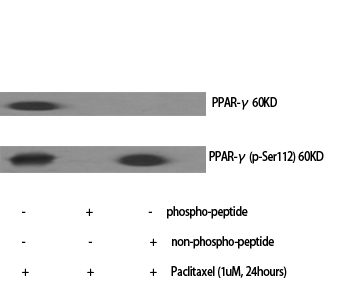
PPAR-γ (Phospho Ser112) Rabbit pAb
YP0316
More→
ELISA Kits
Total PPAR-γ Cell-Based Colorimetric ELISA Kit
KA4252C
More→
ELISA Kits
PPAR-γ (Phospho Ser112) Cell-Based Colorimetric ELISA Kit
KA1326C
More→
Antigen&Target Information
Specificity:
Endogenous
show all
Gene Name:
PPARG
show all
Protein Name:
Peroxisome proliferator-activated receptor gamma
show all
Other Name:
PPARG ;
NR1C3 ;
Peroxisome proliferator-activated receptor gamma ;
PPAR-gamma ;
Nuclear receptor subfamily 1 group C member 3
NR1C3 ;
Peroxisome proliferator-activated receptor gamma ;
PPAR-gamma ;
Nuclear receptor subfamily 1 group C member 3
show all
Background:
peroxisome proliferator activated receptor gamma(PPARG) Homo sapiens This gene encodes a member of the peroxisome proliferator-activated receptor (PPAR) subfamily of nuclear receptors. PPARs form heterodimers with retinoid X receptors (RXRs) and these heterodimers regulate transcription of various genes. Three subtypes of PPARs are known: PPAR-alpha, PPAR-delta, and PPAR-gamma. The protein encoded by this gene is PPAR-gamma and is a regulator of adipocyte differentiation. Additionally, PPAR-gamma has been implicated in the pathology of numerous diseases including obesity, diabetes, atherosclerosis and cancer. Alternatively spliced transcript variants that encode different isoforms have been described. [provided by RefSeq, Jul 2008],
show all
Function:
Alternative products:Additional isoforms seem to exist,Disease:Defects in PPARG are the cause of familial partial lipodystrophy type 3 (FPLD3) [MIM:604367]. Familial partial lipodystrophies (FPLD) are a heterogeneous group of genetic disorders characterized by marked loss of subcutaneous (sc) fat from the extremities. Affected individuals show an increased preponderance of insulin resistance, diabetes mellitus and dyslipidemia.,Disease:Defects in PPARG can lead to type 2 insulin-resistant diabetes and hyptertension.,Disease:Defects in PPARG may be associated with colon cancer.,Disease:Defects in PPARG may be associated with susceptibility to obesity [MIM:601665].,Disease:Variation in PPARG is associated with carotid intimal medial thickness 1 (CIMT1) [MIM:609338]. CIMT is a measure of atherosclerosis that is independently associated with traditional atherosclerotic cardiovascular disease risk factors and coronary atherosclerotic burden. 35 to 45% of the variability in multivariable-adjusted CIMT is explained by genetic factors.,Function:Receptor that binds peroxisome proliferators such as hypolipidemic drugs and fatty acids. Once activated by a ligand, the receptor binds to a promoter element in the gene for acyl-CoA oxidase and activates its transcription. It therefore controls the peroxisomal beta-oxidation pathway of fatty acids. Key regulator of adipocyte differentiation and glucose homeostasis.,online information:Peroxisome proliferator-activated receptor entry,online information:The Singapore human mutation and polymorphism database,polymorphism:Genetic variation in PPARG may influence body mass index (BMI) [MIM:606641]. BMI reflects the amount of fat, lean mass, and body build.,similarity:Belongs to the nuclear hormone receptor family.,similarity:Belongs to the nuclear hormone receptor family. NR1 subfamily.,similarity:Contains 1 nuclear receptor DNA-binding domain.,subunit:Forms a heterodimer with the retinoic acid receptor RXRA called adipocyte-specific transcription factor ARF6. Interacts with NCOA6 coactivator, leading to a strong increase in transcription of target genes. Interacts with coactivator PPARBP, leading to a mild increase in transcription of target genes. Interacts with FAM120B (By similarity). Interacts with NOCA7 in a ligand-inducible manner. Interacts with NCOA1 LXXLL motifs. Interacts with TGFB1I1. Interacts with DNTTIP2.,tissue specificity:Highest expression in adipose tissue. Lower in skeletal muscle, spleen, heart and liver. Also detectable in placenta, lung and ovary.,
show all
Cellular Localization:
Nucleus. Cytoplasm. Redistributed from the nucleus to the cytosol through a MAP2K1/MEK1-dependent manner. NOCT enhances its nuclear translocation.
show all
Tissue Expression:
Research Areas:
>>PPAR signaling pathway ;
>>AMPK signaling pathway ;
>>Longevity regulating pathway ;
>>Osteoclast differentiation ;
>>Thermogenesis ;
>>Non-alcoholic fatty liver disease ;
>>Huntington disease ;
>>Pathways in cancer ;
>>Transcriptional misregulation in cancer ;
>>Thyroid cancer ;
>>Lipid and atherosclerosis
>>AMPK signaling pathway ;
>>Longevity regulating pathway ;
>>Osteoclast differentiation ;
>>Thermogenesis ;
>>Non-alcoholic fatty liver disease ;
>>Huntington disease ;
>>Pathways in cancer ;
>>Transcriptional misregulation in cancer ;
>>Thyroid cancer ;
>>Lipid and atherosclerosis
show all
Signaling Pathway
Organismal Systems >> Endocrine system >> PPAR signaling pathway
Organismal Systems >> Development and regeneration >> Osteoclast differentiation
Organismal Systems >> Aging >> Longevity regulating pathway
Human Diseases >> Cancer: overview >> Pathways in cancer
Human Diseases >> Cancer: overview >> Transcriptional misregulation in cancer
Human Diseases >> Cancer: specific types >> Thyroid cancer
Human Diseases >> Neurodegenerative disease >> Huntington disease
Environmental Information Processing >> Signal transduction >> AMPK signaling pathway
Reference Citation({{totalcount}})
Catalog: YM8211
Size
Price
Status
Qty.
200μL
$600.00
3 weeks
0
100μL
$340.00
3 weeks
0
40μL
$190.00
3 weeks
0
Add to cart
Collected
Collect
Recently Viewed Products
Clear allPRODUCTS
CUSTOMIZED
ABOUT US



Toggle night Mode
{{pinfoXq.title || ''}}
Catalog: {{pinfoXq.catalog || ''}}
Filter:
All
{{item.name}}
{{pinfo.title}}
-{{pinfo.catalog}}
Main Information
Target
{{pinfo.target}}
Reactivity
{{pinfo.react}}
Applications
{{pinfo.applicat}}
Conjugate/Modification
{{pinfo.coupling}}/{{pinfo.modific}}
MW (kDa)
{{pinfo.mwcalc}}
Host Species
{{pinfo.hostspec}}
Isotype
{{pinfo.isotype}}
Product {{index}}/{{pcount}}
Prev
Next
{{pvTitle}}
Scroll wheel zooms the picture
{{pvDescr}}